Announcing the First 5 Fellows of the Philippine Artificial Intelligence Retreat (PAIR)
In the Philippines, a vibrant community of AI pioneers is emerging, leveraging this technology to build solutions tailored to the nation’s unique context.
To foster this growing ecosystem, we are thrilled to organize the first Philippine Artificial Intelligence Retreat (PAIR). We’re announcing the first 5 PAIR Fellows here. In the second half of this post, we also discuss the key themes that guide their work, and why we’re excited to support them.
We’ll announce the remaining Fellows to round up the inaugural cohort of 10 by the end of April.
What is PAIR and Why Now?
PAIR is a unique gathering designed to bring together the leading AI researchers, founders, and engineers who are actively solving real-world problems in the Philippines. Scheduled for June 17-20, 2025, in Silicon Valley, PAIR consists of a 3-day private retreat culminating in a half-day public summit co-organized with the PhilDev Foundation and Stanford University’s US-Asia Technology Management Center.
Our mission is clear: to raise the collective aspirations of the Philippine AI community. We’ll achieve this by helping PAIR Fellows build lasting relationships, exchange cutting-edge ideas, and explore opportunities in the Silicon Valley ecosystem. By connecting Filipino talent with Bay Area AI leaders, we hope Fellows will develop a deeper understanding of the global landscape and bring back applicable insights to catalyze further progress in the Philippines. PAIR seeks individuals with a proven track record of achievement and a commitment to solving problems in the Philippines, whether they are entrepreneurs, researchers, or ecosystem builders.
Meet the Inaugural PAIR Fellows
We are incredibly proud to announce the first cohort of five exceptional individuals selected as PAIR Fellows. Their diverse backgrounds and groundbreaking work exemplify the talent and ambition in the Philippines.
Here are the first 5 PAIR Fellows, in alphabetical order:
Allan Tan: Founder / Chief AI Scientist, Predictive Systems Inc.
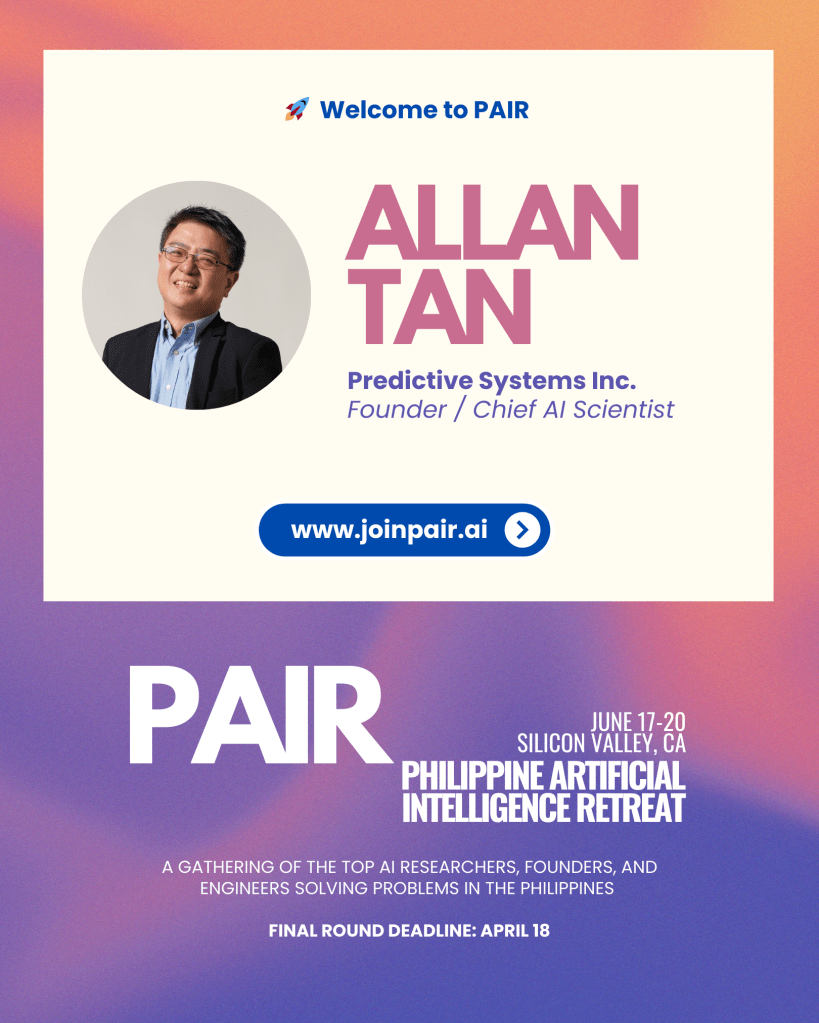
Allan is the founder and Chief AI Scientist at Predictive Systems, Inc., a pioneering AI company focused on building on-premise generative AI solutions (for businesses) that are secure, explainable, and aligned with business goals. Previously, he founded Ideyatech, which scaled and exited to global firm MonstarLab. With over 20 years in tech, he blends hands-on engineering with product strategy.
Currently, Allan is working on Better-Ed, a voice-enabled, AI-powered education platform that assesses student knowledge through natural conversation. Designed for schools and educators, Better-Ed enhances learning retention, boosts engagement, and aligns with the Filipino curriculum.
He also sits on the board of the Philippines Software Industry Association, co-leads Founder Institute Manila – a startup accelerator from Silicon Valley, and helps shape the national IT curriculum for the Commissioner of Higher Education. He also shares AI insights on his YouTube channel, Artificially Intelligent.
Beato Bongco: CEO, Anycase AI
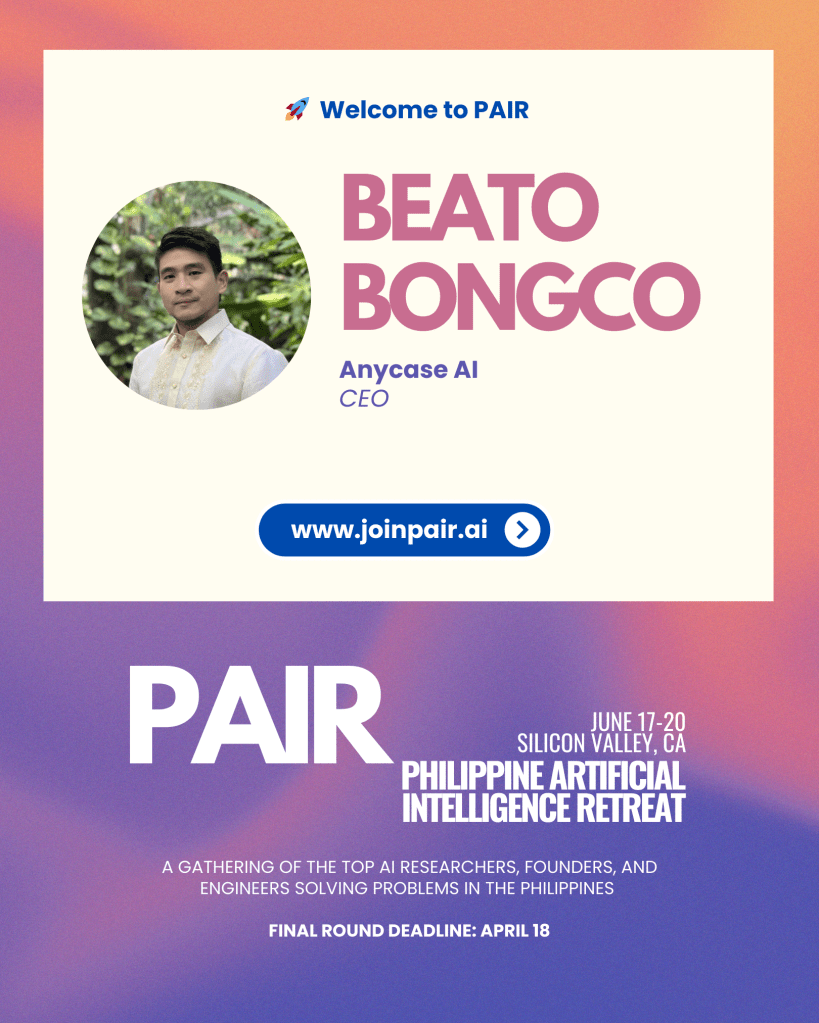
Beato is a builder-CEO and full-stack AI product engineer with a decade of experience shipping systems across the AI stack – from web apps and data pipelines to semantic search engines and production LLM applications.
He’s the cofounder and CEO of Anycase.ai, a legal AI startup augmenting lawyers to make quality legal help accessible to more Filipinos. In its first year, Anycase grew rapidly to 8,000+ users, increased revenue by 20x, and became cash-flow positive, powered by a custom RAG system and evaluation harness benchmarked against Philippine bar exams – with users reporting it cuts their legal research time by 75%.
Previously, Beato led RAG engineering at Bespoke (Tokyo), upgrading their chatbot platform into a multilingual, multi-turn RAG system. Before that, he managed globally distributed engineering teams at a San Francisco-based NLP startup focused on financial and biomedical intelligence, overhauling core algorithms and pipelines.
Earlier, at Thinking Machines (Manila), he led the development of AI-powered document search and retrieval systems for enterprise clients in Southeast Asia. He describes himself as a “RAG-obsessed dilettante”, driven by the dream of building AI systems that help people think, learn, and make better decisions.
Criselle Angeline Peñamante: Master of Medical Sciences in Global Health Delivery, Harvard Medical School
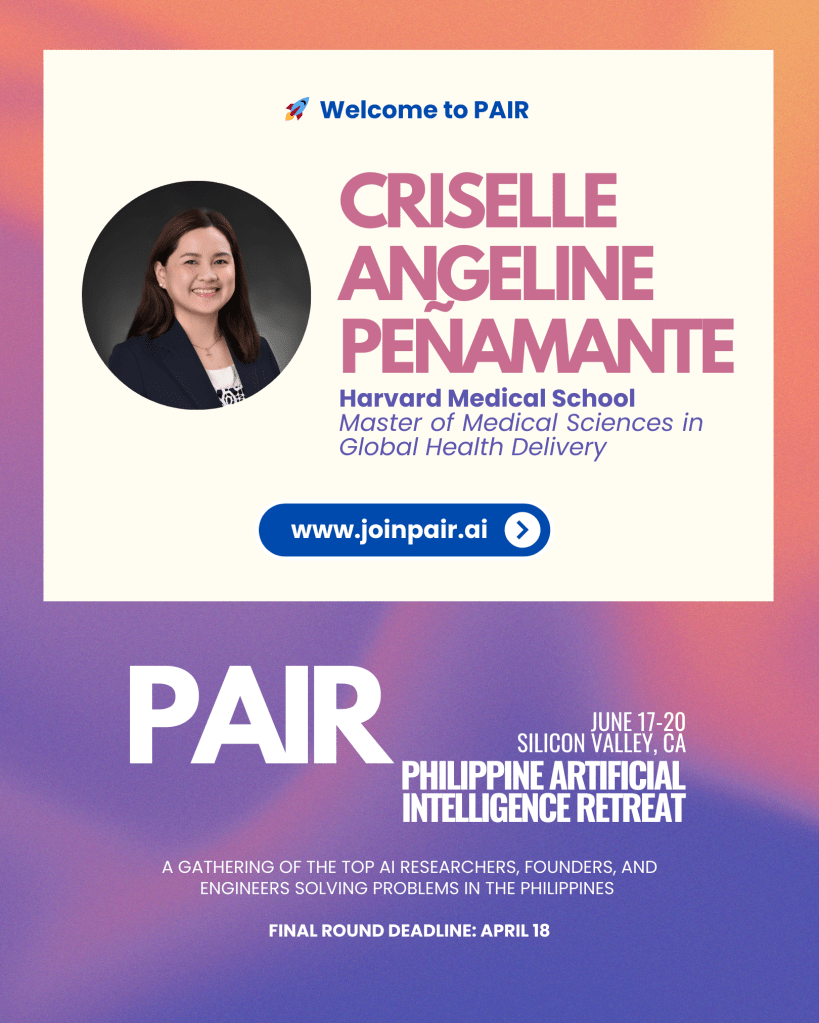
Criselle is a physician, educator, and clinical researcher dedicated to strengthening the Philippine mental health care system through digital innovation. She is currently pursuing a Master of Medical Sciences in Global Health Delivery at Harvard Medical School, where her thesis explores the role of social media in improving mental health service delivery in the Philippines.
Criselle’s work bridges medicine, education, and technology to address gaps in access (to healthcare) and equity, particularly in low-resource settings. As a faculty member at the University of Santo Tomas in Manila, she teaches human anatomy and clinical epidemiology to pre-medical and medical students, while also mentoring future healthcare professionals.
Criselle is actively engaged in global and local initiatives, serving as Director of Culture, Diversity, and Inclusion at Harvard Alumni for Mental Health. Her advocacy centers on harnessing digital platforms to support community-based care, reduce stigma, and empower mental health systems. Through research, teaching, and leadership, she aims to drive meaningful change in how mental health services are delivered and understood in the digital age.
Gian Paulo dela Rama, Chief Product and AI Officer, Sprout Solutions
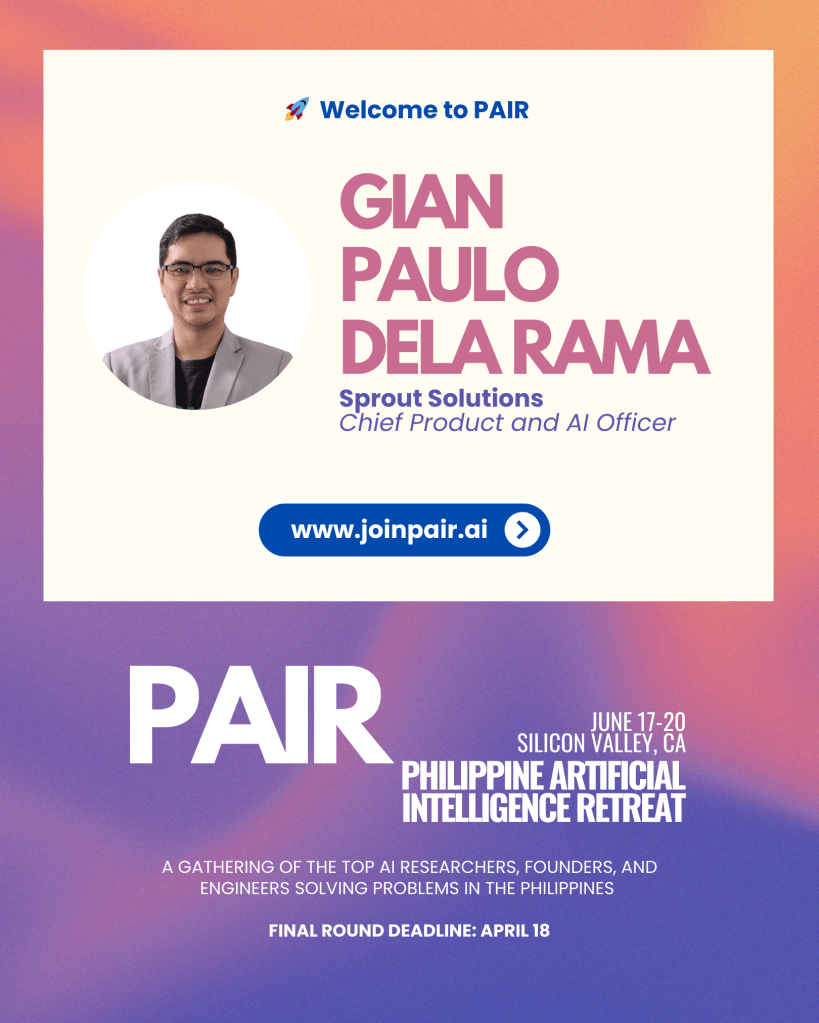
Gian dela Rama is a pioneering force in the Philippine AI and startup ecosystem. He is the founder of Aiah.Ai, a trailblazing AI company that built natural language processing (NLP) chatbots to automate lead generation and customer service workflows for large enterprises. Aiah also played a critical role in the nation’s pandemic response by developing KIRA, the official COVID-19 chatbot of the Philippines.
Under Gian’s leadership, Aiah was recognized as one of the Philippine Daily Inquirer and Statista’s 2023 Growth Champions, ranking 4th among the fastest-growing companies in the country. In the same year, Aiah achieved a milestone exit through its acquisition by Sprout Solutions, becoming one of the first AI startups in the Philippines to successfully exit.
Gian now serves as Chief Product and AI Officer at Sprout, where he leads the Sprout AI Labs team in developing next-generation enterprise AI agents. His team launched Concierge, a generative AI RAG chatbot that automates enterprise knowledge retrieval; Inbound, an AI-powered sales development rep tailored for automotive and real estate sectors; and Sidekick, an automation agent designed to handle payroll, HR, and other BPO processes. Notably, Sidekick has automated over 70% of the manual processes in Sprout’s payroll outsourcing unit, enabling the business to more than double its revenue without increasing headcount.
He is also spearheading the transformation of Sprout’s product development process through the use of AI agent–assisted software development, rethinking how its design, product management and engineering teams build, ship, and scale its products.
Outside of Sprout, Gian teaches at the Ateneo de Manila University in the Information Technology Entrepreneurship Program, serves as the Technology Venture Partner of the GenAI Fund, a regional venture capital firm, and is a proud father of two. His work reflects a deep commitment to advancing the AI ecosystem in Southeast Asia while helping shape the next generation of innovators and builders.
JP Madulid: Deputy CEO, Symph
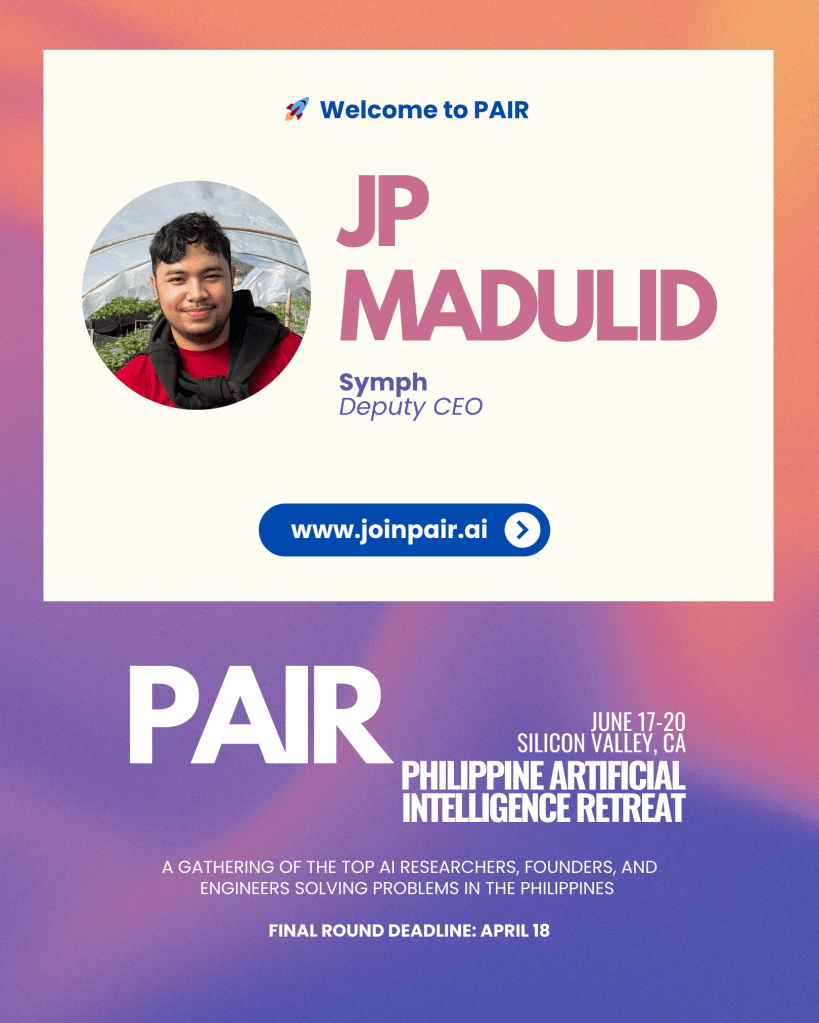
JP Madulid is the Deputy CEO of Symph, a software design and development company that leverages cloud technologies and AI to create solutions for startups, government agencies, and enterprise companies. He works alongside the CEO to shape the company’s future, focusing on AI innovation and strategy. This includes driving investments in AI development, research, and product-building to enhance Symph’s technology offerings.
JP is also the Founder of Lesson Planner PH, an AI-driven platform designed to simplify lesson planning and class preparation for teachers. They have established a partnership with the Department of Education and was awarded the Philippine’s DICT Startup Grant Fund to further develop their product and bring it to the hands of every Filipino educator. To date, it has helped over 400,000 teachers, generated 3 million lesson plans, and saved teachers more than 10 million hours of preparation time. With the power of AI, he aims to “Drive positive global impact by building products for every problem affecting human life”.
Key Themes from Fellows’ Work: AI’s Growing Impact in the Philippines
The pioneering work of our inaugural Fellows reflects the specific use cases of AI applications to solve key national priorities:
Democratizing Access to Social Infrastructure through AI
Anyone who’s done business in the Philippines will have their war stories on interfacing with the legal system. When I was running a startup there many years ago, we felt first hand the immense complexity of situations that would otherwise be simple and seamless in other countries – such as registering a business, seeking regulatory clarity when laws contradict each other, and doing legal research.
Fellows like Beato are tackling this head-on with Anycase AI, leveraging advanced RAG systems to make legal research dramatically more efficient (cutting time by 75% for users) and accessible.
People see the failure of the legal system on the front page news each day: the arrest of former president Rodrigo Duterte is just the tip of the iceberg of tens of thousands of extrajudicial killings that are backlogged by decades in the country’s court system. And fundamentally, the human capital cost of the drug problem can trace itself upstream to mental health access for young Filipinos living through a time of unprecedented economic and technological change, with many living in broken families due to OFW migration.
Similarly, Criselle’s research explores using digital platforms and social media to improve mental health service delivery, a critical need given the high internet usage for health information in the Philippines (Filipinos spend 10 hours online daily vs. 6 globally). While digital health adoption, like EMRs, is still developing unevenly, AI offers a pathway to bridge gaps, especially in geographically isolated areas.
Transforming Education to Deliver Personalization at Scale: The Philippine education system faces hurdles, underscored by recent PISA rankings. AI presents a powerful tool for support. JP’s Lesson Planner PH has already assisted over 400,000 teachers, saving millions of hours in prep time. Allan’s Better-Ed focuses on conversational AI for personalized learning assessment.
These initiatives align with national efforts, such as the Department of Education’s partnership with Microsoft to integrate AI tools like Reading Coach, and the broader push for digital literacy outlined in RA 11899 (EDCOM II Act). While the EdTech market is still nascent, AI can help overcome resource limitations and personalize learning, boosting engagement and outcomes.
Boosting Enterprise Efficiency to enable Filipino Companies to Compete Globally: The BPO sector, a vital economic engine contributing ~7-8% of GDP, is rapidly integrating AI. While concerns about job displacement exist (with IMF reports suggesting high exposure for many BPO roles), the reality is more nuanced. AI is increasingly viewed as an augmentation tool, driving demand for higher-value skills. 67% of Philippine BPO companies reported implementing AI in 2024, and the industry projects continued job growth overall, albeit requiring upskilling.
Gian’s work at Sprout exemplifies this – automating over 70% of manual payroll tasks doubled revenue without increasing headcount, shifting focus to higher-level functions. His efforts, alongside Beato’s focus on enterprise RAG systems and Allan’s work on secure, on-premise AI, reflect the broader trend of leveraging AI for efficiency and competitive advantage.
Building a Robust National AI Ecosystem: The success of individual AI ventures depends on a supportive environment. The Philippines is making strides, improving its Government AI Readiness ranking and launching initiatives like the National AI Strategy Roadmap 2.0 and a Centre for AI Research. Government agencies like NEDA and DTI are actively formulating policies, aiming to make MSMEs AI-ready.
The startup scene is maturing, with increased funding in 2024 and AI-powered platforms becoming a key investment theme. Fellows like Gian (startup founder, educator, VC partner), Allan (founder, industry board member, accelerator lead), and JP (bridging startups, government, and enterprise) are not just building products; they are actively strengthening this ecosystem through mentorship, education, investment, and policy engagement. This ecosystem-building is vital, as adoption is already high among Filipino knowledge workers (86% use AI at work).
These themes – access, education, enterprise transformation, and ecosystem building – are crucial for the Philippines’ trajectory. By fostering talent like our PAIR Fellows and supporting strategic AI adoption, the nation can build a more inclusive, efficient, and innovative future.
The journey of these five Fellows represents the vanguard of AI innovation in the Philippines. We are excited to support them through PAIR as they connect with global leaders, refine their visions, and return with renewed energy to build a future where AI benefits all Filipinos.
Stay tuned for more updates from PAIR and insights from our Fellows!
